
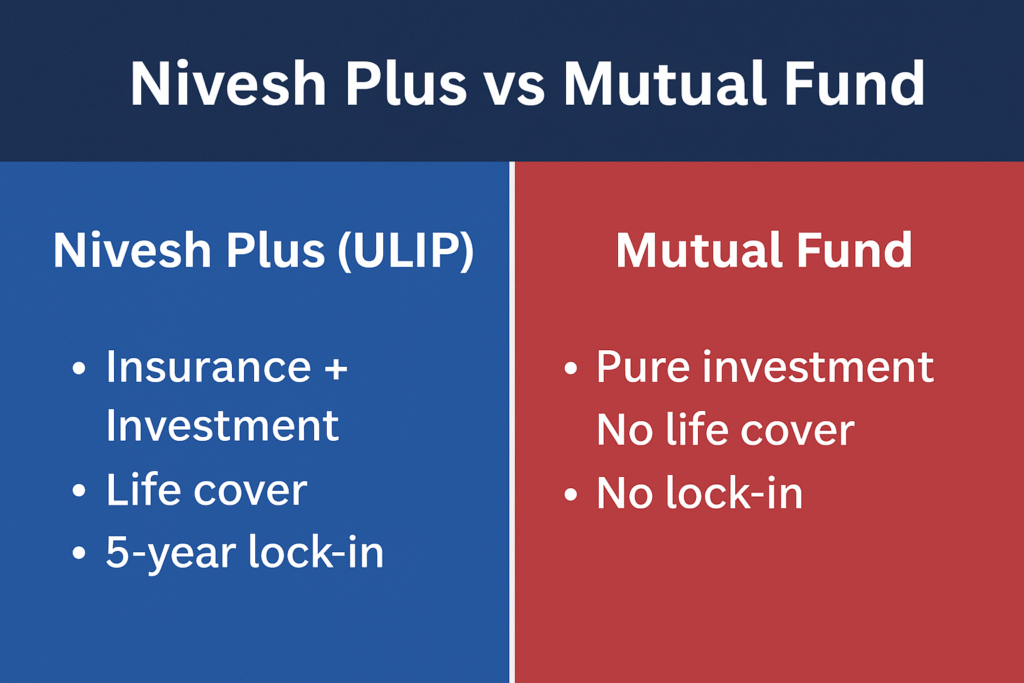
🔵 Nivesh Plus (ULIP) kya hai?
Nivesh Plus ek ULIP plan hai (insurance + investment).
Yani aapka paisa do parts me jaata hai—
- Life insurance cover
- Market-linked investment (equity/debt funds)
But isme 5 saal ka lock-in hota hai. Early withdrawal allowed nahi hota.
🔴 Mutual Fund kya hai?
Mutual fund ek pure investment product hai.
Isme koi insurance cover nahi hota.
Aapka paisa pool hoke stocks, bonds ya hybrid funds me invest hota hai, professional fund manager ke through.
Liquidity high hoti hai—kabhi bhi withdraw kar sakte ho (exit load depend karta hai).
⭐ Side-by-Side Comparison
| Feature | Nivesh Plus (ULIP) | Mutual Fund |
|---|---|---|
| Purpose | Insurance + Investment | Sirf Investment |
| Life Cover | ✔️ Haan, life insurance milta hai | ❌ Nahi |
| Lock-in | Minimum 5 years | Usually No lock-in (except ELSS: 3 yrs) |
| Returns | Moderate to market-linked | Higher potential (specially equity funds) |
| Charges | High: policy charges + fund charges | Low: only expense ratio |
| Risk | Market risk + insurance cost | Pure market risk |
| Liquidity | Low (5 years band)** | High (open-ended funds) |
| Tax | ULIP maturity mostly tax-free | Mutual fund gains taxable (as per rules) |
| Best for | Jo log insurance + investment ek sath chahte hain | Jo log wealth creation chahte hain |
🔍 Example Return Comparison (5 / 10 / 15 Years)
1. LIC Nivesh Plus (ULIP)
Based on LIC’s own illustration & expert-analysis:
- LIC’s brochure assumes gross returns of 8% p.a. for its projections. insufinplanet.com+2Personal Finance Plan+2
- But due to ULIP charges (mortality charge, fund management charge, policy charges), the net return becomes lower: around 5.05% to ~6.5% p.a. depending on the “sum assured” option. Stable Investor+2Personal Finance Plan+2
- According to LIC’s benefit illustration (for their ULIP), at projected 8% gross rate, the net yield works out to ~6.79% (for some assumptions). licpolicywala.com
Hypothetical growth (using net return ~6.5% p.a. for simplicity):
| Period | Approximate Growth (if ₹ 1,00,000 invested as single premium) |
|---|---|
| 5 years | ~ ₹ 1,34,000 (because 1,00,000 * (1.065)^5 ≈ 1.34 lakh) |
| 10 years | ~ ₹ 1,80,000 (1,00,000 * (1.065)^10 ≈ 1.80 lakh) |
| 15 years | ~ ₹ 2,42,000 (1,00,000 * (1.065)^15 ≈ 2.42 lakh) |
(These are rough numbers, actual ULIP value will depend on how LIC’s funds perform, what exact charges you incur, and which fund option you pick.)
2. Mutual Funds (Equity)
For mutual funds, let’s take some plausible long-term return-rates based on recent / historical data:
- There are equity mutual funds that have given 5-year CAGR > 15%. The Economic Times+1
- Some funds (especially small-cap / mid-cap) have had 10-year CAGR in the 20%+ range. For example, AngelOne’s data shows 10-year returns ~20-23% for certain funds.
- Over 15 years, some consistent mutual funds have delivered ~17-20% CAGR, according to a 15-year performance list. Myinvestmentideas
Let’s take a moderate but optimistic assumption for mutual funds:
- Assume 10% p.a. CAGR for a well-diversified equity mutual fund (conservative long-term equity return estimate)
- Also show a 15% p.a. CAGR scenario (for a more aggressive / very good equity fund)
Hypothetical growth for Mutual Funds:
| Assumption | Period | Growth of ₹ 1,00,000 (assuming lump sum) |
|---|---|---|
| 10% p.a. | 5 years | ~ ₹ 1,61,000 (1,00,000 * 1.10^5) |
| 10 years | ~ ₹ 2,59,000 (1,00,000 * 1.10^10) | |
| 15 years | ~ ₹ 4,17,000 (1,00,000 * 1.10^15) | |
| 15% p.a. | 5 years | ~ ₹ 2,01,000 (1,00,000 * 1.15^5) |
| 10 years | ~ ₹ 4,05,000 (1,00,000 * 1.15^10) | |
| 15 years | ~ ₹ 8,16,000 (1,00,000 * 1.15^15) |
✅ Comparison Summary (5/10/15 Years)
- Over 5 years, mutual funds (even with a modest 10% return) could give significantly higher growth than Nivesh Plus ULIP (because ULIP’s net return might be ~6-6.5%).
- Over 10 and 15 years, the difference becomes very large:
- If mutual funds grow at 10%, you might more than double (or more) your money in 15 years.
- If you pick a high-performing equity fund (15% p.a.), the growth is exponential compared to ULIP net returns.
- On the other hand, ULIP like Nivesh Plus gives insurance cover, which mutual funds don’t. So part of the “cost” (mortality, policy) is for that insurance benefit.
⚠️ Things to Keep in Mind / Caveats
- Past Returns ≠ Guarantee: Just because mutual funds gave 15% CAGR in past doesn’t mean all will do the same in future.
- ULIP Charges Vary: ULIP returns are sensitive to charges (mortality, fund management, admin). If your charges are high, net returns will be lower.
- Fund Choice Matters: In both ULIP and mutual funds, the type of sub-fund (equity, debt, balanced) you choose will impact returns a lot.
- Tax & Liquidity: Withdrawals, taxation, and policy exit terms matter.
- Investment Horizon: Longer horizon generally favors equity-based mutual funds if you’re comfortable with risk.
ремонт бытовой техники рядом https://remont-tehniki-na-domu-ekaterinburg.ru/